Annunciation Painting Now Displayed in Our Lyceum Auditorium
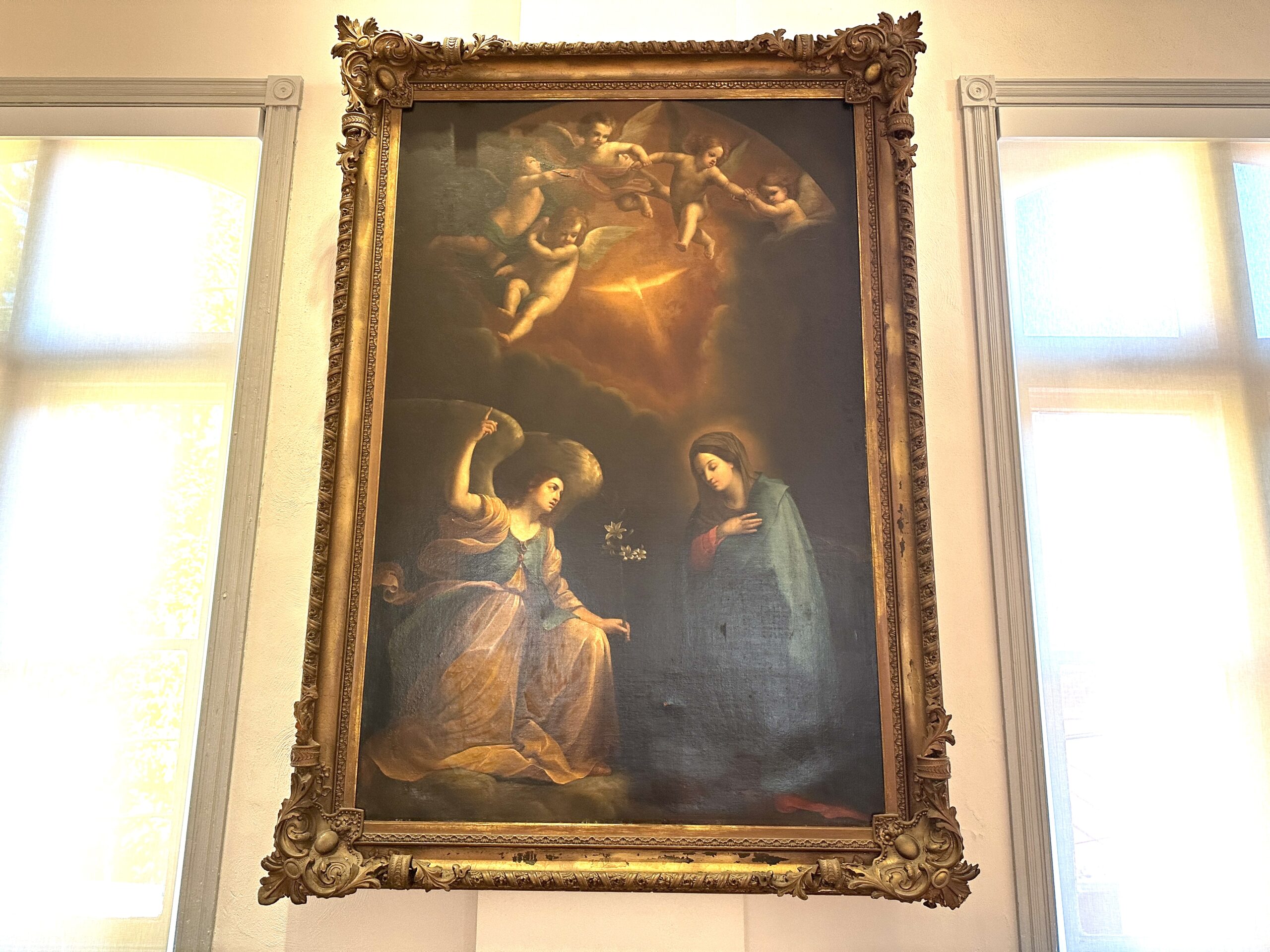
Now hanging in our Lyceum auditorium, 313 Duke Street, is a beautiful painting of the Annunciation of the Blessed Virgin Mary. The painting came to the Basilica from Saint Charles Borromeo Seminary in Philadelphia, where it hung in a corridor for years. When the Archdiocese of Philadelphia opened a new campus for the seminary this summer, many of the works of art that hung in the old seminary building found new homes in other churches and religious institutions. Both our Father Hathaway and Father Searby attended seminary at Saint Charles Borromeo and remember passing this impressive work on their way to class.
Unfortunately, we know almost nothing about the painting’s provenance. But here’s what we can say, according to Virginia Nyce, our parish’s archival manager: it is a massive piece, measuring just over 7 feet by 9 feet and weighing more than 200 pounds. On the left side of the canvas, we see the Archangel Gabriel depicted with lilies in one hand, and his other hand pointing upward. The lilies are a traditional symbol of purity. In this context they symbolize Our Lady’s virginity. His gesture upward indicates that the message he is giving comes from God; it is also a gesture that traces its roots to “chironomia” – the art of hand gesticulations, used by Roman rhetoricians. An extended index finger was used not only to indicate a particular place or object, but it was also a gesture of speaking. We frequently see ancient Roman statues of various emperors and statesmen depicted with their arms and index finger extended, as if addressing an audience. Here, Saint Gabriel’s extended finger recalls his famous address, “Hail, favored one. The Lord is with you” (Luke 1:28).
To the right of Gabriel, Our Lady’s response can be read in her own gestures – she crosses her arms over her breast, an act of humble submission. In paintings of the Annunciation, artists choose to depict Mary in a variety of positions, to portray the various stages of her experience. Traditionally, those stages are Conturbatio (disquiet, when Mary is astonished by the angel’s greeting), Cogitatio (reflection, when she ponders what the greeting means), Interrogatio (inquiry, when she asks, “How can this be?”), Humiliatio (submission, when Mary gives her Fiat), and Meritatio (merit, when the Holy Spirit overshadows her, and Jesus is incarnated in her womb).
Each stage is portrayed by a variety of gestures. Here, her crossed arms, lowered gaze and bowed head all suggest the moment when Mary responds, “Behold, I am the handmaid of the Lord. May it be done to me according to your word.” Above Our Lady’s head in the painting, we see the Holy Spirit descending upon her in the form of a dove. At her feet is a low, wooden stool, reminding us that Mary is the Seat of Wisdom; just behind her is an open book, symbolizing the Word of God, Who became flesh through her humble “Yes.”